
So you’ve spent ages crafting that perfect opening sentence to your novel. You’ve discarded several attempts and rewritten several others. Finally you have it: precise words, in a precise order, all selected and carefully arranged to both grab the reader’s attention and convey to them a precise sense of what they’re in for should they continue on. Lovely! Job well done, that author there.
Then, somehow*, this first perfect sentence is dropped on the way from the publisher to the printer and your novel’s actual opening is in fact what you intended to be its second sentence.
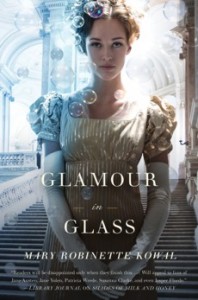 Horror story? Urban legend from the publishing world? Unfortunately not. This, along with the omission of several other corrections, is what has happened with Mary Robinette Kowal’s new novel, Glamour in Glass, which is due for release tomorrow. I would probably still be curled up in a corner somewhere, alternately wailing and gnashing my teeth. Mary, on the other hand, has devised a more elegant response in the form of a fun quiz on her blog wherein you match second sentences to their rightful homes in ten famous novels — and, you know, some of those second sentences would have been a damn fine way to actually start out on — along with downloadable bookmarks and stickers with the correct opening line printed on them. Or, if you’re lucky enough to get to a signing, Mary will handwrite the opening sentence in your book for you. As someone still very much enamoured with the notion of books as artefacts and objets d’art, I cannot tell you how much I love that idea!
The errors and omissions will be corrected immediately in the digital book and then in subsequent print editions, so one of these misprinted hardcovers will make a very fine collectable for fans of the author. But don’t wait to buy the book, because there likely won’t be a corrected hardcover edition if the first print run doesn’t sell out.**
∞
* I can’t help but picture this poor little dropped sentence running and puffing along after the rest of the book, shouting plaintively, “Wait for me! Oh, please wait for me!”
** I also can’t help but compare this to a similar situation with Jonathan Franzen’s Freedom, and wonder just what kind of literary heft you need to wield in order to deserve pulping and immediate reprinting . . .
.
 Kirstyn McDermott